
What Is FPA in Your MEPCO Bill? Fuel Price Adjustment Explained
If you’ve looked at your MEPCO bill and seen a line marked FPA, you’re not alone in wondering what it is. FPA stands for Fuel Price Adjustment, and it’s one of the main reasons two months with almost the same units can add up to very different totals. This page explains what it is, why it changes, and how it’s worked out, in plain terms.
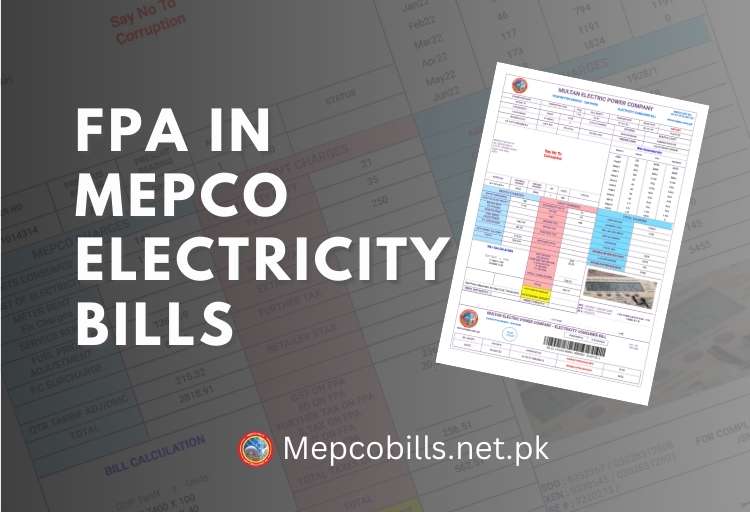
What Is FPA?
Most of Pakistan’s electricity comes from power plants that burn fuel, such as furnace oil, natural gas, and imported LNG, alongside cheaper sources like hydel and nuclear. The cost of that fuel changes every month.
When NEPRA sets the electricity tariff, it assumes a certain fuel cost. The Fuel Price Adjustment is the difference between that assumed cost and what fuel actually cost in a given month.
If fuel cost more than assumed, a positive FPA is added to your bill. If it cost less, the FPA is negative, and you get a small credit instead. It is not a fixed charge; it is a monthly correction that can go either way.
Why FPA Changes Every Month
- Fuel prices: the international prices of oil, gas, coal, and LNG move constantly, and Pakistan imports a large share of its fuel.
- The exchange rate: because that fuel is bought in dollars, a weaker rupee raises the cost of the same fuel.
- The generation mix: in months with more cheap hydel power, fuel costs fall and FPA can drop or turn negative. In peak summer, plants lean on costlier furnace oil, and FPA tends to rise.
Who Decides the FPA
MEPCO doesn’t set the FPA itself. It’s decided nationally each month and applied the same way across all distribution companies:
- The Central Power Purchasing Agency (CPPA-G), which buys electricity on behalf of the distribution companies, submits the month’s actual fuel-cost data to NEPRA.
- NEPRA holds a public hearing where consumers and industry can raise objections.
- NEPRA issues a formal determination setting the FPA rate per unit, which then appears on bills.
Because of this process, the FPA on your bill usually reflects fuel costs from one to three months earlier, not the current month. That lag is why your bill can jump even when your usage didn’t change.
How FPA Is Worked Out on Your Bill
On your bill, the FPA is simple to check. It’s a rate per unit, multiplied by the units you used:
FPA amount = FPA rate per unit × units consumed
For example, if the FPA rate for the month is Rs 2.00 per unit and you used 300 units, the FPA on your bill is 300 × Rs 2.00 = Rs 600. If NEPRA sets a negative FPA of Rs 0.50 per unit that month, the same usage would instead show a credit of Rs 150. GST is charged on the FPA amount too, so it affects your tax as well.
To work out your own FPA, note the FPA rate NEPRA announces for the month, or read it from your bill, and multiply it by your units. To estimate the rest of your bill, try our MEPCO bill calculator, keeping in mind it doesn’t include the FPA because that changes every month.
FPA vs the F.C. Surcharge
These two are easy to confuse, but they’re different. The FPA changes every month and can be positive or negative. The financing cost (F.C.) surcharge is a small, fixed per-unit charge that helps service power-sector debt, and it doesn’t move month to month the way FPA does.
The Bottom Line
FPA passes the real, changing cost of fuel through to consumers, up in some months and down in others. You can’t negotiate it, since it’s a NEPRA-set rate applied to everyone, but you can reduce its impact by using fewer units, especially in high-cost summer months. Checking the FPA line each month helps you understand why your total moved.